Home · Costs & Insurance
Stuart fire restoration costs, counted from the day the fire was found
A fire was found days later in my vacant Stuart home. What does restoration cost, and does the vacancy hurt the claim?
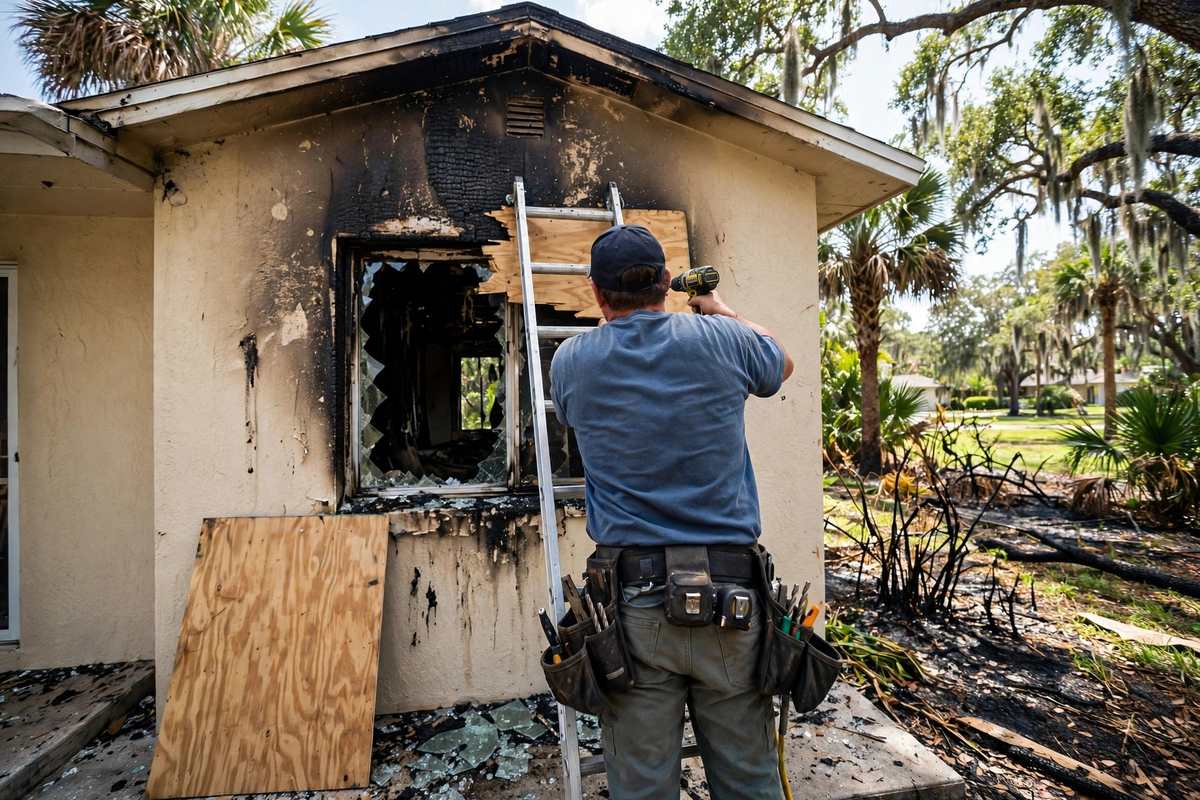
Discovery delay is Stuart's defining fire fact, because so many of its homes sit empty between seasons. A fire found by a neighbor or a home-watch visit has usually burned out on its own or been rained on through a failed roof section, so the restoration reads less like a single event and more like an archaeology: which rooms took flame, which took smoke, which took days of Treasure Coast humidity through wet drywall. Cleanup for contained events still starts where the national guides put it, in the thousands, and the total grows with the delay more than with the flame size. The vacancy question has an honest answer. Many Florida policies carry vacancy and unoccupancy conditions that can limit or void fire coverage beyond a stated window, and the only safe move is to surface the occupancy facts in the first claim call, with the home-watch records that show the property was monitored. Concealment discovered later converts a coverage question into a credibility one, and credibility is the whole claim.
Stuart's fire bills carry a line no other city in this region writes quite the same way: the days between the event and its discovery. Soot left sitting in coastal humidity etches glass and pits metal; water pooled in wall bases starts growth that a next-day dry-out never allows. So the honest cost table for a seasonal-home fire starts with stabilization against the humidity, not with the room that burned, and the guides' contained-event band, in the thousands, applies to the event itself rather than to its waiting period.
Compiled from published national guides and local data; reviewed by the Sailfish Fire Restoration research team. Last reviewed November 16, 2026.
Typical cost ranges
| Job | Typical range | What moves it |
|---|---|---|
| Emergency stabilization and dry-out | Priced from the building read | Board-up, extraction, and drying placed against the humidity clock. In Stuart this row outranks cleaning in urgency, whatever the fire's size. |
| Smoke and soot remediation, delay-adjusted | In the thousands for contained events | The published band for the event; set soot and corroded surfaces from delay are scoped on the readings, room by room. |
| Contents triage: save, hold, discard | By inventory line | Nothing irreversible before the owner reviews the inventory; electronics and metals are time-critical and are flagged as such on the list itself. |
| Structural repair and rebuild | From permitted plans | Martin County permitting and inspections named as schedule gates, with the seasonal calendar stated plainly if work spans a return north. |
| Odor sealing and final clearance read | At scope close | Thermal fogging or sealing only after source material is out; clearance documented with readings, not assurances. |
A Stuart estimate that ignores discovery delay is priced for a fire someone watched happen. Ask which lines assume the delay your home actually had, and have the answer in the scope.
How insurance pays for this work
The deductible question
Vacancy is the claim issue Stuart owners lose sleep over, and the loss is usually self-inflicted by silence. Policies commonly restrict fire coverage when a home sits vacant beyond a set period, but a monitored seasonal home with home-watch visits, maintained utilities, and a documented occupancy pattern is a materially different file from an abandoned one. Lead with those records. The deductible, commonly $500 to $2,500 on standard policies, is a footnote next to getting the vacancy question answered in your favor, and it is answered on documents, not on reassurance.
Request a callback
Prefer to talk later? Leave your details and an independent local pro will call you back. No charge to you, no obligation.
Sailfish Fire Restoration is a free referral service. Submitting this form connects you with independent local contractors who provide the work.